






Forecast Origin Dates
The J-SCOPE forecast system for Washington and Oregon coastal waters presents preliminary results for the 2026 upwelling season. Currently, conditions in the equatorial pacific are ENSO-neutral. The CFS forecast El Niño is likely to emerge soon (82% chance in May-July 2026) and continue through Northern Hemisphere winter 2026-27 (96% chance in December 2026 –February 2027). In comparison to the climatological data, during the summer upwelling season (May-August), coastal regions are forecasted to have slightly higher sea surface temperatures (SST) with the warm anomalies extending deep subsurface in Oregon, but restricted to the mid shelf in Washington. Bottom oxygen is forecasted to be lower than normal in the Washington and Oregon shelf waters over the upwelling season. Hypoxia is forecasted earlier than climatological (June) at both CEO42 and NH-10, with one ensemble member developing hypoxia in July. Hypoxia is forecasted to develop at Ćháʔba· as well, which is not typical. Chlorophyll concentrations vary spatially but are forecasted to be slightly lower on the Washington shelf and over Heceta Bank early in the upwelling season, and near climatology over the rest of the upwelling season. Bottom Ω is forecasted to be undersaturated throughout the upwelling season, with the exception of supersaturated conditions on shallow nearshore Washington shelves early in the upwelling season. Surface Ω is forecasted to be supersaturated throughout the upwelling season for all coastal areas.
The forecast system predicts the timing of the spring transition from downwelling to upwelling, the cumulative upwelling index, sea-surface temperature (SST), primary production, chlorophyll stock, dissolved oxygen, and sardine habitat. The forecast for 2026 is composed of three model runs that make up an ensemble. Each model run is initialized at a different time (April 5, April 15, April 25), and has complementary forcing files from the large scale model, CFS. The details of the wind forcing for each model run can be found on the California Current Indicators tab. For each of the predicted quantities listed above, we report the ensemble average anomaly as well as the relative uncertainty within the ensemble, which is defined as the standard deviation of the ensemble divided by the mean of the ensemble and is reported as a percentage of the mean. All of these quantities are reported as monthly averaged anomalies from our April-initialized reforecast climatology, which spans 2009-2017. An anomaly is an indication of how different conditions are to what they have been in the past. For more information about anomalies, please see the NANOOS Averages & Anomalies App. These predicted quantities are key indicators for the California Current Integrated Ecosystem Assessment report.
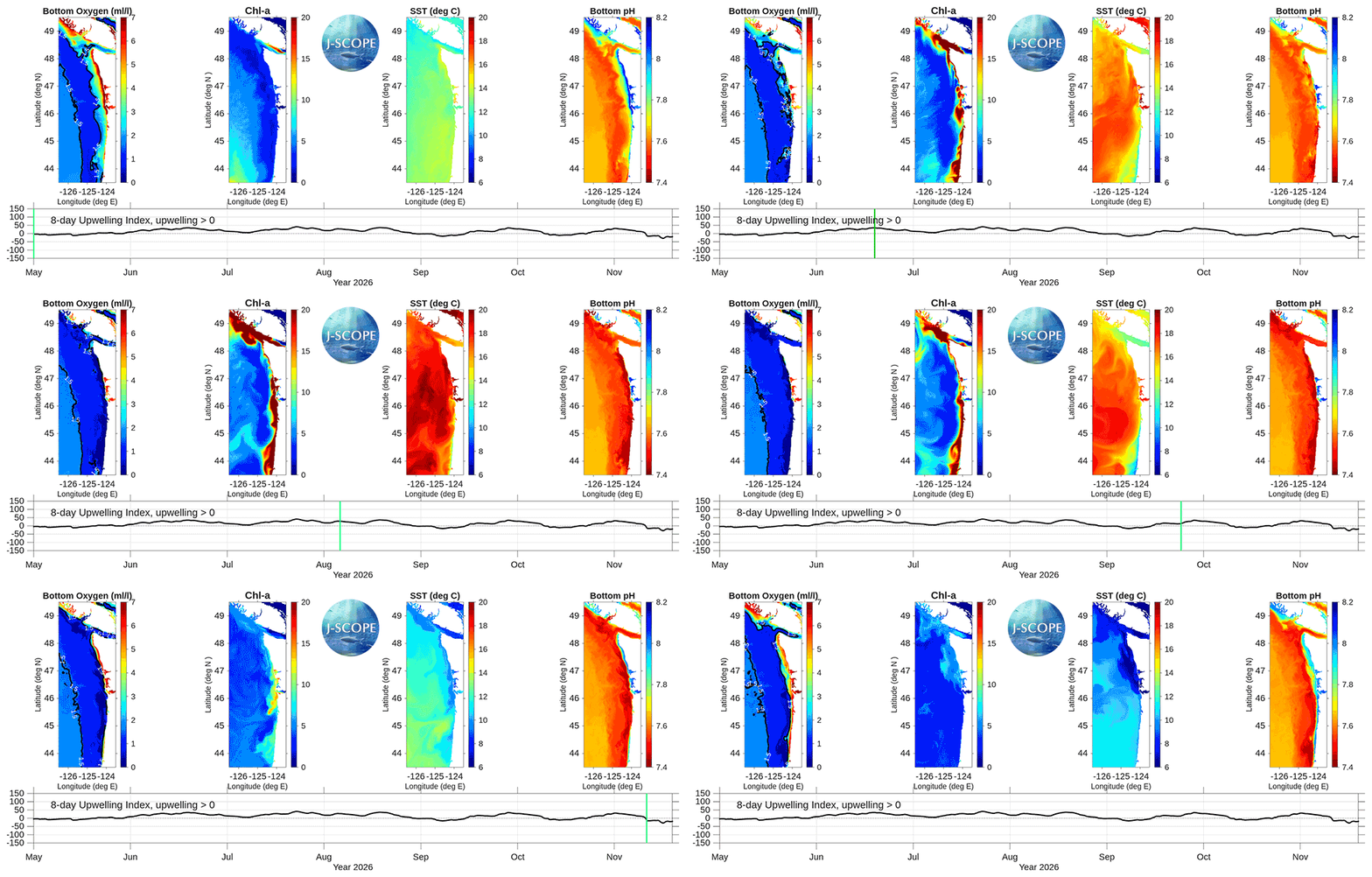
The movie above shows the J-SCOPE forecast for 2026, from ensemble model run 3 initialized on April 25. More information about the three panels on the left can be found by navigating the Oxygen, Chlorophyll, and Sea Surface Temperature tabs above. The panel on the far right depicts the evolution of bottom water pH over the forecast period. The pH field is calculated using an empirical relationship established by Alin et al., in prep. This work is part of a collaboration between Samantha Siedlecki, J-SCOPE, and the Ocean Acidification group at NOAA PMEL. The 8-day upwelling index is calculated using the method described in Austin and Barth (2002) and can also be found under the California Current Indicators tab above.